


What is an options lock-up period?
An options lock-up period is the period after exercising stock options during which the acquired shares cannot be sold. Lock-up periods are common in start-ups and other companies that do not have a public market for their shares.
During a lock-up period, an employee may already legally own the shares but is unable to convert them into cash. This can create a practical issue when income tax becomes due, as the employee cannot sell the shares to generate money to pay the tax.
Dutch tax rules since 1 January 2023
As of 1 January 2023, the Dutch tax authorities changed the way employee stock options are taxed. Under the new legislation, the tax authorities assume that employees are generally unable to pay income tax when they exercise their options.
For this reason, taxation is now deferred by default. Income tax is due only when the employee sells the shares acquired by exercising the options. This applies even if the employee has already exercised the options.
In practice, this means employees can exercise their options, receive the shares, and pay income tax only when the shares are sold and cash becomes available.
Choosing when to pay tax: pay now or pay later
Although taxation is deferred by default, employees can still pay income tax when they exercise their options. This choice must be made consciously and requires action from both the employee and the employer.
Some employees choose to pay tax immediately because the share value at the moment of exercise is relatively low. Paying tax at that moment can result in lower taxable income and, in some cases, lower total tax than paying later when the share value has increased.
If no action is taken, the default rule applies, and taxation is automatically deferred until the shares are sold.
How to pay tax at the moment of option exercise
If an employee wants to pay income tax immediately when exercising options, the following steps must be followed.
First, the employee must inform the employer in writing of their wish to pay income tax at the time of exercise. I think this written indication must be provided before or at the moment the options are exercised.
The employer must store this written request as part of the employee’s salary administration.
Next, the employer processes the option exercise through payroll. The taxable gain is calculated as the current value of the shares at the time of exercise minus the price the employee paid to acquire the shares.
This taxable gain is added to the employee’s salary as a one-time extra gross salary. As a result, the total gross wage for that month increases, and more income tax is due for that month. The employer pays this income tax to the Dutch tax authorities through the regular payroll process.
Because the employer pays the tax upfront, the additional tax amount must be settled with the employee. This can be done by asking the employee to pay the amount in cash, either immediately or over time, or by deducting the amount from a future net salary payment.
How to pay tax at the moment of option exercise
If an employee wants to pay income tax immediately when exercising options:
- The employee informs the employer in writing, before or at the moment of exercise.
- The employer stores this request in the salary administration.
- The employer processes the option exercise through payroll.
- The taxable gain is calculated as the share value at exercise minus the price paid.
- This gain is added as a one-time extra gross salary, increasing income tax for that month.
- The employer pays the income tax via payroll.
- The employee settles the additional tax with the employer, either:
- By paying cash, or
- Via deduction from a future net salary.
How this appears on the payslip
When options are exercised, and tax is paid immediately, the employee’s payslip for that month will look different from a regular payslip.
The payslip will show two gross salary components: the normal gross salary and a one-time extra gross salary representing the taxable gain from exercising the options.
On the net salary side, the payslip will also show two components. The normal net salary is paid out to the employee’s bank account. The net amount related to the option gain is not paid out because the employee has already received this value in the form of shares.
This structure allows employees and employers to clearly see how much tax was paid on the exercise of the options.
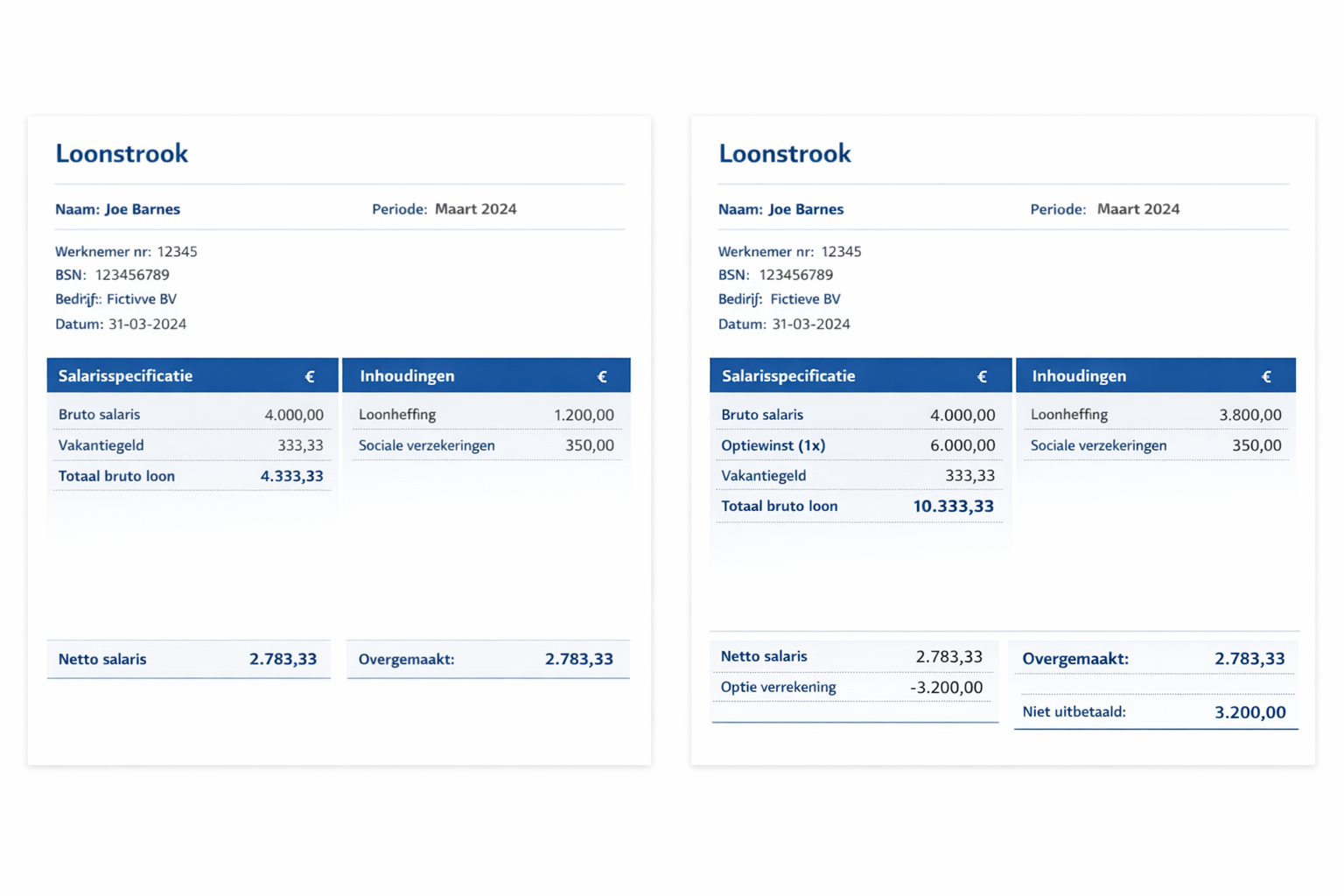
Payslip examples and practical comparison
To make this process easier to understand, we will add practical payslip examples to this page.
One example will show a normal payslip without option execution, reflecting a regular salary for the month. Another example shows a payslip that includes a one-time gross extra wage due to an option exercise.
By comparing these two payslips, employees can see how the option gain affects gross salary, how much additional income tax was paid, and which amounts were paid out versus settled through share ownership.
These examples are intended to provide transparency and help employees understand the financial and tax impact of exercising options, even without detailed payroll knowledge.
.png?width=1536&height=1024&name=Image_20260319_143150_164%20(1).png)
Overall
Since 1 January 2023, income tax on employee stock options in the Netherlands has been deferred by default until the shares are sold. This helps employees avoid paying tax when shares cannot yet be sold due to a lock-up period.
Employees who expect strong future growth may still choose to pay tax at the time of exercise, but this requires a written request and employer payroll processing.
Clear communication and proper payroll handling are essential to ensure that both employees and employers understand their obligations and options.
Share this

Long-Term Incentive Plans (LTIPs) and Stock Options: Strategies for Employee Retention

The Benefits of Options: Flexibility and Potential Returns