![Share-council-wit.svg]](https://sharecouncil.co/hubfs/Website/Share-council-wit.svg)
On Share Council, a portfolio's latest valuation sets its price per share. The recommended way to get that valuation is Equidam, which merged with Share Council in February 2026 and combines five valuation methods weighted by your company's stage. The second-best way is a discounted cash flow (DCF) valuation that you build yourself. Either way, you record the result on the portfolio's Valuation tab with Add a valuation.
What a valuation does on Share Council
The latest valuation sets the price per share that transfers use by default, the suggested price on a trading day and, for the circle's first shares portfolio, the company value a percentage hurdle is measured against. It does not set the Exercise price of options: that is stored on each grant. Each valuation is stored with its date and shown in the valuation chart.
The recommended way: an Equidam valuation via Share Council
Equidam combines five methods: the Scorecard and Checklist methods, a DCF with long-term growth, a DCF with multiples, and the Venture Capital method. It weights them by the company's stage: at the idea stage the two qualitative methods carry 38% each, and at maturity the two DCF methods carry 50% each. Equidam has valued more than 160,000 companies since 2013. The report shows each method, the weighted result and a value range, with financial projections and benchmarks.
Why we recommend it over a single DIY DCF:
- A DCF of a young company leans on its terminal value. Equidam writes that terminal value "usually accounts for the bulk of a DCF result on an early-stage company". Weighting five methods makes the result depend less on one forecast.
- Equidam brings market data you do not have in a spreadsheet: multiples from more than 30,000 public companies, updated weekly.
- For employee participation, you need a price you can explain every year. A report that shows every method and input shows how you got the number, and you can repeat it next year.
How it works in the product:
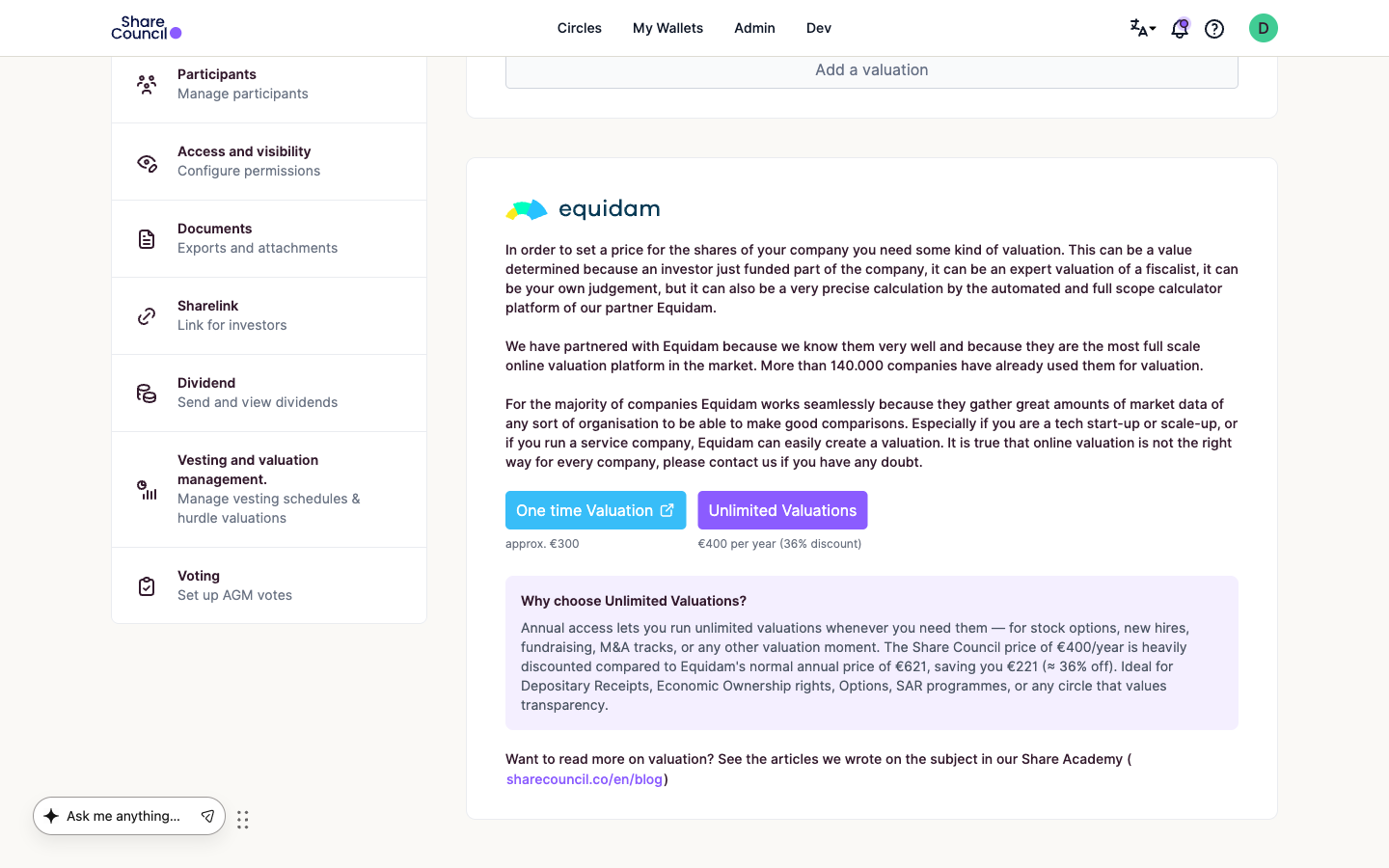
- Open the portfolio, click Portfolio settings and go to the Valuation tab. Below Add a valuation you find the Equidam card.
- One time Valuation takes you to Equidam's website for a single valuation.
- Unlimited Valuations needs the Valuations (Equidam) add-on. An Owner or Administrator turns it on in the circle settings under Billing > Features; others see a message asking a circle admin to do it. The add-on needs annual billing and is not available on Try-out Ownership.
- After you switch it on, you and your circle's administrators get a welcome email, and Equidam contacts you to set up your account. From then on the tab shows Make online valuation, which opens your Equidam dashboard.
- Equidam does not send its result to Share Council automatically: enter it with Add a valuation and attach the report.
The pricing page shows which plans include Equidam valuations and what they cost.
Second best: a DCF valuation you do yourself
A DCF values a company today from the cash it is expected to generate. The steps follow the Corporate Finance Institute (CFI) DCF formula guide.
- Forecast free cash flow, the cash left after operating costs, taxes and investments. CFI notes that 5 years is the typical forecast period.
- Choose a discount rate. CFI writes that it "is typically a firm's Weighted Average Cost of Capital (WACC)". The riskier the forecast, the higher the rate.
- Discount each year: divide its cash flow by (1 + discount rate) to the power of the year number.
- Calculate the terminal value with CFI's perpetuity growth formula: last year's cash flow × (1 + g) / (discount rate − g), where g is the long-term growth rate. Discount it with the last year's factor.
- Add everything up for the enterprise value. Subtract debt and add cash for the equity value (enterprise value vs equity value), then divide by the number of shares.
- Test other scenarios, changing one input at a time, and note the range.
For g, Aswath Damodaran (NYU Stern) writes that "no firm can grow forever at a rate higher than the growth rate of the economy" (The stable growth rate).
A worked example
Discount rate 10%, long-term growth 2%, debt €200,000, cash €50,000, 100,000 shares issued. Values today are rounded to whole euros.
| Year | Free cash flow | Discount factor (1.10^year) | Value today |
|---|---|---|---|
| 1 | €100,000 | 1.1 | €90,909 |
| 2 | €110,000 | 1.21 | €90,909 |
| 3 | €120,000 | 1.331 | €90,158 |
| 4 | €130,000 | 1.4641 | €88,792 |
| 5 | €140,000 | 1.61051 | €86,929 |
| Total, years 1–5 | €447,697 |
- Terminal value: €140,000 × 1.02 / (0.10 − 0.02) = €1,785,000; today €1,785,000 / 1.61051 = €1,108,345.
- Enterprise value: €447,697 + €1,108,345 = €1,556,042.
- Equity value: €1,556,042 − €200,000 + €50,000 = €1,406,042.
- Price per share: €1,406,042 / 100,000 = €14.06.
When a DIY DCF is acceptable, and where it is weak
A DIY DCF can work for a company with steady, predictable cash flows and someone who can defend the inputs. Its weak points are the ones this example shows. The terminal value is about 71% of the enterprise value, and raising the discount rate from 10% to 12% drops the price per share to €10.85. A spreadsheet also has no comparable companies to check the result against.
How to record either valuation on Share Council
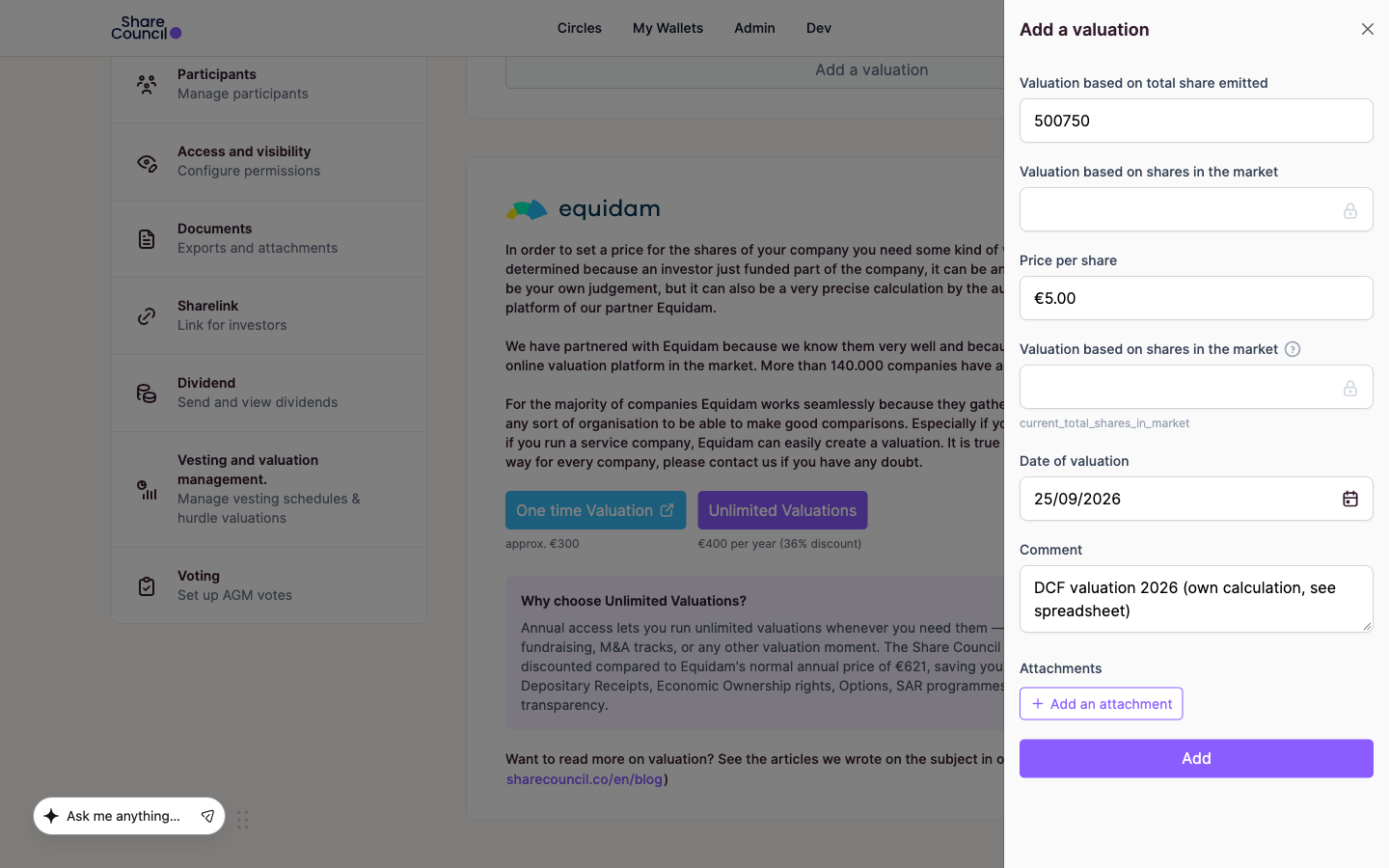
An Owner, Administrator or Portfolio Admin opens the portfolio, clicks Portfolio settings, then the Valuation tab and Add a valuation. Fill in the total valuation, the Price per share, the Date of valuation and a comment, and use Add an attachment for the Equidam report or your spreadsheet. Depositary receipt and economic ownership right (EOR) portfolios follow the shares portfolio they are linked to. See How can I change the valuation?.
Frequently asked questions
Does Share Council calculate the valuation for me?
No. Share Council records the valuation you enter, with its date, price per share and attachments. You, your adviser or Equidam do the calculation.
Which discount rate should I use in a DCF?
There is no single right number. CFI describes WACC as the usual rate, and the rate rises as the forecast gets riskier. A young company with uncertain cash flows usually carries more risk than an established one. An adviser or Equidam can help you choose.
Is an Equidam valuation accepted by the Belastingdienst?
We found no rule that accepts or rejects any valuation report. For Dutch wage tax on employee options, the Belastingdienst (Dutch Tax Administration) uses the waarde in het economisch verkeer (economic value) of the shares at the taxable moment. Neither Handboek Loonheffingen 2025 §4.11 nor article 13 Wet LB 1964 prescribes a valuation method.
Does a new valuation change the exercise price of existing options?
No. The exercise price is stored on each grant. A valuation on an options portfolio changes only the options' price.
This article explains how the rules and the platform work. It is not tax advice. Share Council does not calculate, withhold or file taxes for you or your employees. Check your own situation with a tax adviser. Source: Handboek Loonheffingen 2025, Belastingdienst.
Related articles
- Equidam valuations with Share Council
- How can I change the valuation?
- Adding a valuation for depositary receipts
Last updated: 27 September 2026.