There is no fixed option pool size in the Netherlands. Size it from the people you plan to hire before your next round. As a reference point, Index Ventures found European seed pools are usually set at 10% and stay around that level in later rounds (Index Ventures, Rewarding Talent). This guide is for Dutch founders setting up a plan.
Tulpwerk is a demo company we set up in Share Council, so its names and numbers are invented.
This is general information, not legal or tax advice. Check your situation with a lawyer or tax adviser, or book an expert hour.
Key takeaways
- An option pool is a number of options reserved for future grants. In a Dutch BV it is often a pool of options on STAK certificates, and no shares are issued when you create it.
- Index Ventures reports that European seed pools usually start at 10%, while US pools grow to 15% at Series A and 20% or more by Series D (Index Ventures).
- A pool created before a funding round dilutes the existing shareholders; a pool created after it dilutes the new investor too (Viotta Law).
- Options that come back from leavers return to the pool and can be granted again.
- Read your pool on a date as five numbers: pool, unallocated, outstanding, vested and unvested.
What is an option pool?
An option pool is the total number of options your company sets aside for employees, decided once and granted over time. It is a reservation, so no shares are issued when you create it. Each grant takes options out of the unallocated part, and the rest waits for future hires.
In the Netherlands many companies give options on certificates of shares instead of on the shares themselves. A STAK (stichting administratiekantoor, the foundation that holds the shares and issues certificates) keeps the votes, and the employee gets the economic value. Our post on why Dutch companies combine a STAK with an option plan explains that choice. Our employee stock options page shows how that kind of plan runs on Share Council.
How big are option pools in practice?
The most cited dataset is Index Ventures' handbook Rewarding Talent. It says seed pools are traditionally set at 10%, that US pools usually grow to 15% at Series A and to 20% or even 25% by Series D, and that European pools flat-line at around 10%, with a range of 4% to 20% by Series D (Index Ventures). Its own bottom-up model lands on a 12% pool to cover hiring up to a Series B, and Index expects most companies to fall between 10% and 15%.
Those numbers describe venture-backed tech companies. The handbook is an updated version of a December 2017 edition, and it gives no separate pool figure for the Netherlands. A family-owned BV that wants to give twenty staff a stake has a different starting point from a startup that plans to hire fifty engineers. Many web pages and AI answers quote pool ranges for each round with no dataset behind them. Treat those as opinion.
How do you size the pool from your hiring plan?
Count the people you expect to grant options to before your next round or in the next two to three years, give each role a grant size, and add room for refreshes. Index advises that the pool should cover all your talent needs through to your next round, because you won't want to revisit it between rounds (Index Ventures).
The table below is an illustration for a company with 1,000,000 shares. The grant sizes are invented to show the method, so don't use them as a benchmark.
| Group (illustrative) | People | Options each | Options |
|---|---|---|---|
| Senior hires (e.g. head of sales, lead engineer) | 2 | 15,000 | 30,000 |
| Experienced staff | 4 | 6,000 | 24,000 |
| Early-career staff | 6 | 2,000 | 12,000 |
| Room for refresh grants and surprises (about 25%) | 16,500 | ||
| Pool | 12 | 82,500 (about 8% of today's shares) |
Then run two checks. First, ask whether each grant would mean something to the person who receives it at today's valuation. Second, compare your total with the benchmarks above. A pool far above them needs a reason your investors will accept, and a pool far below them may leave you short when you hire. If you want to check how many options a plan lets you grant, see How many options can I sell/issue?
Should you create the pool before or after a funding round?
It changes who pays for the dilution. If the pool is created before the round, in the pre-money valuation, the existing shareholders (usually the founders and earlier investors) carry the dilution. If it is created after the round, all shareholders share it, including the new investor (Viotta Law).
The pre-money version is common in VC term sheets (Viotta Law). Index notes that some accelerators argue the investor should then raise the pre-money valuation to make room for a larger pool (Index Ventures). Either way, it is a negotiation point in the term sheet, so model both before you agree. Our simple explanation of share dilution walks through the arithmetic.
Who holds the pool in a Dutch BV with a STAK?
With options on certificates, the STAK is often the party that grants the options and delivers certificates when someone exercises. Your plan rules and the STAK's trust conditions decide this.
Where the certificates come from depends on your set-up. If the STAK already holds enough shares, it issues certificates against them and the company issues no new shares. If the company has to issue new shares for the pool, three rules of Dutch law apply. The general meeting decides on the issue unless the articles name another body, and the same rule applies to granting rights to take shares (art. 2:206 BW). The issue needs a notarial deed (art. 2:196 BW). And existing shareholders have a pre-emption right on new shares, with an exception for shares issued to employees unless your articles say otherwise (art. 2:206a BW). Whether that exception applies when the shares go to the STAK instead of the employee is a question for your notary. Your shareholders' agreement may add a consent right for investors on top of this (Viotta Law).
What happens to options that come back?
When an employee leaves, the options that haven't vested go back to the pool, and you can grant them to someone else. What happens to the vested part depends on your plan's leaver rules.
On Share Council you stop vesting for the leaver on their leaving date. The unvested options go back to the party that granted them, which accepts or declines the return. Share Council doesn't apply good or bad leaver categories for you.
How do you keep track of the pool?
Track five numbers on any date: the pool, the unallocated options, the outstanding options, and how many of those are vested or unvested. Pool = unallocated + outstanding, and outstanding = vested + unvested. If your spreadsheet doesn't add up that way, something is missing.
Worked example: Tulpwerk's pool on 16 October 2026
Tulpwerk B.V., a furniture maker in Utrecht, started "Optieplan medewerkers 2022" on 1 June 2022 with a pool of 60,000 options on certificates, 4-year vesting and a 1-year cliff. Against Tulpwerk's 1,000,000 shares (900,000 for the founders at founding and 100,000 issued in the 2022 round), that pool is about 6% of the share capital. The Index figures describe venture-backed tech startups, so they say little about a furniture maker like Tulpwerk.
| On 16 October 2026 | Options |
|---|---|
| Pool | 60,000 |
| Unallocated | 20,834 |
| Outstanding | 39,166 |
| of which vested | 29,768 |
| of which unvested | 9,398 |
Jesse left on 31 August 2024. He kept 2,166 vested options, and the other 1,834 went back to the pool, where they count as unallocated again.
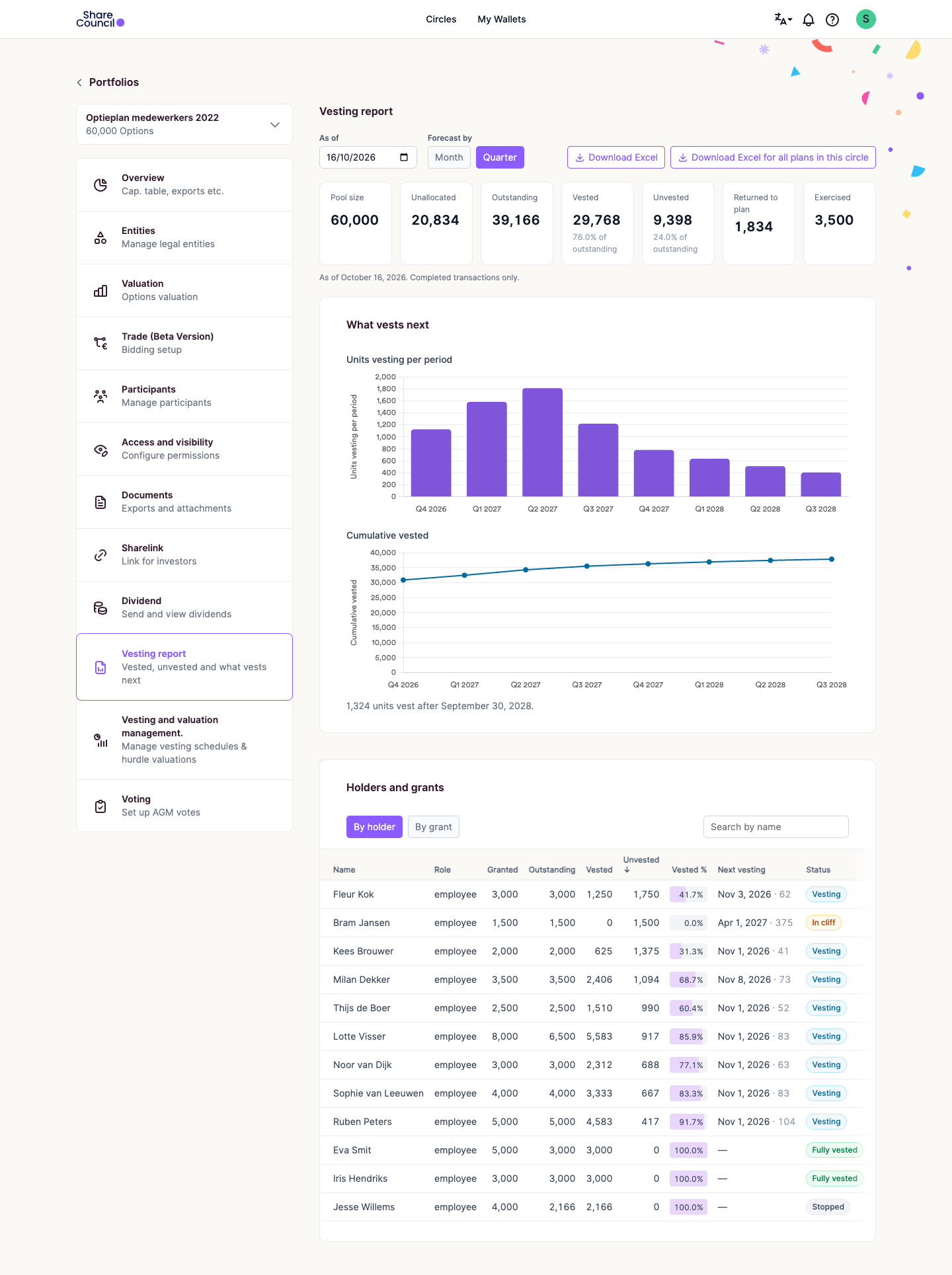
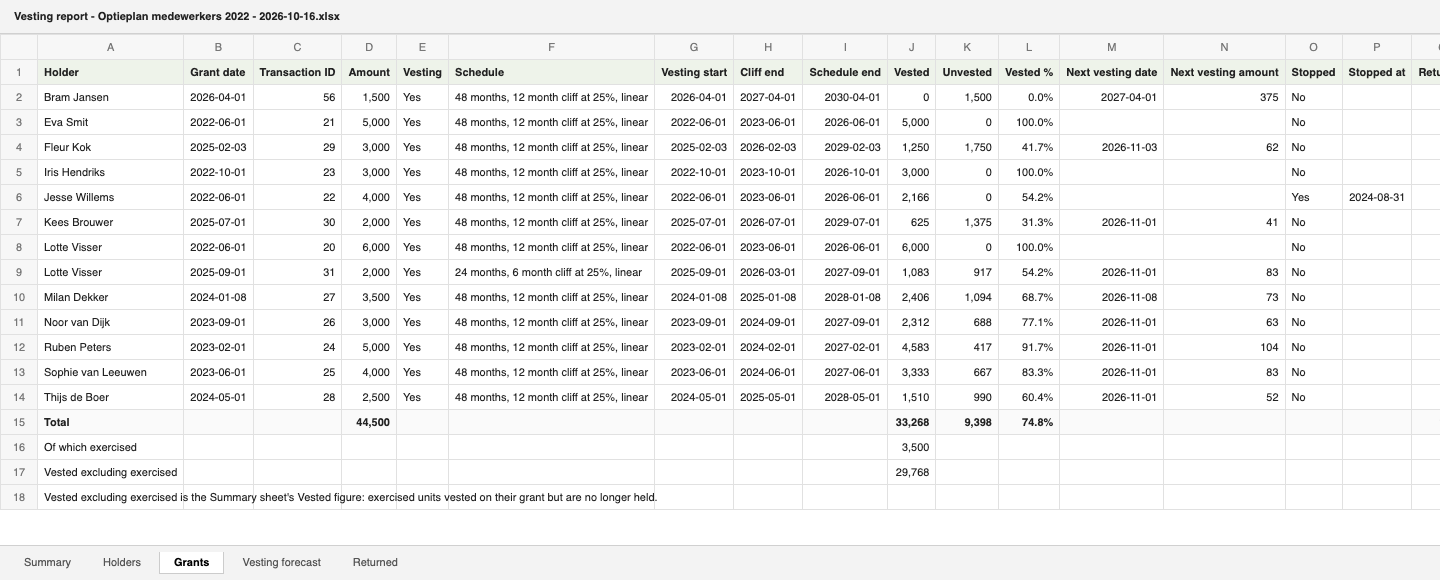
The vesting report shows these tiles for any as-of date, with a forecast of what vests next. You can download the plan to Excel for your accountant, per plan or for the whole company.
What Share Council does and doesn't do
Share Council records your option plan, its pool and every grant, shows the pool on any date and exports it to Excel. You create the plan as a draft and finalise it when the terms are right. Options on certificates need a paid plan. Share Council has no pool calculator, so you decide the size with your co-founders and investors. Our team helps with the legal and tax questions around a plan, and we work with the notaries who handle any share issue. For your own situation you can book an expert hour.
FAQ
Can you enlarge the pool later?
Yes. A larger pool usually needs the same approvals as the first one: a decision by the general meeting or the body your articles name, and often investor consent under the shareholders' agreement (Viotta Law). Index describes top-ups at each funding round as common practice (Index Ventures). Your articles, shareholders' agreement and plan rules set the exact route.
Does a pool dilute employees who already hold certificates?
Creating the pool reserves options and doesn't change anyone's holding. Dilution happens when new shares are issued. If exercised options are covered by shares the STAK already holds, no new shares are issued.
Should you state the pool as a percentage or a number of options?
Write a number of options in the plan, because that is what the plan grants and what you track. Use the percentage to talk to investors and to compare with benchmarks, and recalculate it after every round, since new shares change it.
Do you have to grant the whole pool?
No. Index warns against promising the whole pool to early employees (Index Ventures). Unallocated options are room for later hires.
Set up your option pool on Share Council
For the full set-up, read how to set up options. See how the plan, pool and vesting report work on the employee stock options page.
Share this
How to explain stock options and certificates to your employees

Employee Ownership and Retirement Planning