What is a STAK?
Updated: October 2026
A STAK (stichting administratiekantoor, often translated as a Dutch trust office foundation) is a foundation that holds shares in your BV and issues depository receipts, called certificaten, to your employees. The certificate holders get the economic rights: their part of the dividends and of the proceeds if the company is sold. The STAK keeps the voting rights, and its board votes on the shares. That split is why the STAK is a common choice for employee ownership in the Netherlands. People share in the value they help build, while decisions stay with a small group. The knowledge base article on the STAK covers the legal background.
Who a STAK is for
A STAK suits a Dutch BV that wants to make several employees co-owners without adding each of them to the shareholder register. The STAK stays a single shareholder in your register whether 5 or 150 people hold certificates.
With a very small team it is usually too early. Quintus Willemse, founder of Share Council, puts it this way: "As a small company with three owners and one first employee, we often say: hold off on setting up that foundation. The only reason to set it up now is if you know you'll have 10 employees by the end of the year."
How Share Council sets up and runs your STAK
On the Co-Ownership Starter plan you start with options over a future STAK. All the STAK paperwork is prepared up front: statutory articles, trust conditions (administratievoorwaarden), valuation method and rules of engagement. You can grant options to your team in about a week, without a notary. Each grant gets a defensible strike price from the Equidam valuation that comes with the plan.
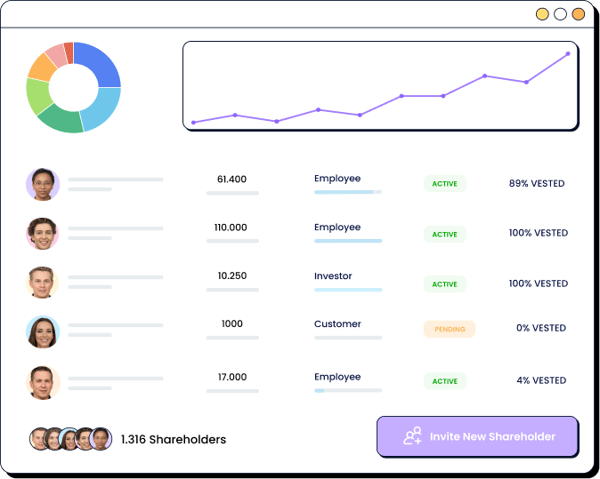
When you are ready to formalise, typically around your first funding round or a wave of hiring, you send one email and we arrange the formation of the STAK at the notary. The options then sit over the new STAK. From then on the platform keeps the register of certificates, vesting, transfers between employees, leavers and dividend payouts, so nobody has to maintain it in a spreadsheet.
Companies with more than about 25 employees or a more complex structure go on the Scale plan, where an onboarding manager handles the notary setup for you.
What it costs
Prices as of October 2026, excluding VAT, from the pricing page:
- Co-Ownership Starter: €2,490 for the first year (includes 2 hours of setup support), then €1,990 a year, billed yearly. Billed monthly it is €253 a month in the first year and €202 a month after that.
- Formation of the STAK at the notary: €1,950, one-off, whenever you are ready.
- Scale: from €439 a month billed yearly, for 25+ employees and custom legal structuring.
An example
A software company with 14 employees wants to give its first five employees a stake. In year one it takes Co-Ownership Starter for €2,490 and grants options over a future STAK at a strike price based on its Equidam valuation. Eighteen months later it raises a seed round and asks us to form the STAK, which costs €1,950. Over those two years the company has paid €6,430 excluding VAT: €2,490, then €1,990 for year two, plus €1,950 for the notary. The five employees now hold options over certificates in a formed STAK, and the founders still vote on all the shares through the STAK board.
Frequently asked questions
Do employees get voting rights?
Usually not. The board of the STAK votes on the shares it holds. The articles of your BV can give certificate holders meeting rights, meaning the right to attend and speak at the shareholders' meeting (article 2:227 of the Dutch Civil Code). You decide this when the structure is drafted.
Do I need a notary?
To form the STAK, yes. A foundation is set up by notarial deed (article 2:286 of the Dutch Civil Code), and moving BV shares into the STAK also needs a notarial deed (article 2:196). After that, certificates move between people without a notary, which is the practical advantage over giving employees shares directly. On Co-Ownership Starter you can start with options before the STAK exists.
Does granting early save tax?
No. In the Netherlands an option is not taxed when you grant it, and the tax lands on the gain later. Granting early is about fairness: people who join early get in at today's lower valuation. Our post on the 2027 option rules explains what is changing.
What happens when an employee leaves?
The rules of engagement set what happens to vested and unvested options and certificates when someone leaves, including whether the STAK or other holders buy them back. See removing or buying out someone from the STAK.
STAK or SARs?
SARs pay out the increase in value as a bonus and never make anyone a shareholder. A STAK makes people co-owners. See options and SARs and SAR vs STAK to compare.
Read more
- Why the STAK offers a practical employee participation model
- How to set up a STAK in the Netherlands (step-by-step guide)
- Certificates on shares
Start for free and set up your first grants in about a week.
Transfer certificates without a notary
One shareholder instead of many
Separate voting and economic rights
“We have set up our STAK in such a way that everyone is not only co-owner, but also co-responsible.”

Peter DeSmet CEO
Founder & CEO Solar Clarity

Want to see how another company did it?
Read how Solar Clarity set up its STAK and made its employees co-owners.
Prefer to have it explained first? Join our webinar, or start for free and try the platform yourself.
Join the #1 platform for co-ownership
Digitize the administration of owners and shareholders
Establish vesting schedules and contract rules
Customize the voting rights
Manage employee participation plans
Trade stocks when someone leaves
Pay out dividends in minutes
Online shareholder and contract management
Start a community funding round
Create 1 Billion+ Shares
Send shares easily with a link
Discover an initial, tailor-made quote on how co-ownership could be structured for your company.
You may also be interested in
Read more about STAK and other forms of participation

Automation and AI: A Blessing or a Threat to Employee Engagement?

The Role of AI in Managing STAK Structures and Share Administration