Steward ownership disadvantages fall into two groups. Some come with the model, such as a lower price than an open sale would bring (Accountancy Vanmorgen, 2026) and a structure that is hard to undo (Holland Management Review, 2025). Others you can manage, mainly set-up cost, unclear roles and the yearly administration.
This article is for Dutch owners who are weighing steward ownership. It gives a source for each disadvantage and shows the administration on our demo company. What we do for steward-owned companies is on our steward ownership page.
Tulpwerk is our demo company. The numbers are made up, the screens are real.
This is general information, not tax or legal advice. Check your own situation with your adviser, or book an expert hour with our team.
Key takeaways
- Owners who move to steward ownership sell their shares to a foundation, for example against a subordinated loan that is paid off over time, and they ask what price is "enough" rather than aiming for the highest bid.
- Investors who expect control through their votes are a poor fit, so outside money has to come from investors who accept a limited return without a decisive vote.
- Researchers call irreversibility an important disadvantage, because the say over going back to a conventional structure lies with the stewards.
- The roles of stewards, board and supervisory board are often poorly defined, and a governance researcher recommends recording them in advance.
- The extra administration comes back every year, with two registers that must agree, a deed for each certificate transfer, a yearly price and, where the trust conditions provide one, a meeting of certificate holders.
What are the main steward ownership disadvantages?
We count seven. Four come with the model: a lower sale price, a hard road to a later sale, fewer investors and a structure that is difficult to reverse. The other three depend on how well you organise it.
| Disadvantage | Why it happens | Accept or manage | What keeps it small | Source |
|---|---|---|---|---|
| Lower price than an open sale | You sell to a foundation, not to the highest bidder, and it may pay you over several years | Accept | A dated valuation with a report; agree up front what "enough" means to you | Accountancy Vanmorgen, 9 Oct 2026 |
| A later sale to an outside buyer is hard | The structure exists to prevent takeovers, so a sale depends on the stewards and on your articles | Accept | Decide before you start whether a sale must stay possible | Holland Management Review, 2025; AWVN, 30 Oct 2025 |
| Fewer investors | Traditional investors expect control through their votes | Accept | Mission-driven investors who take a limited return without a decisive vote | Holland Management Review, 2025; AWVN, 30 Oct 2025 |
| Hard to undo | The say over the structure lies with the stewards, and they rarely agree to give it up | Accept | Design it carefully, and consider starting with part of the shares | Holland Management Review, 2025 |
| Unclear roles between stewards, board and supervisors | The steward role is often poorly defined, and there are no specific statutory rules or case law to fall back on | Manage | Write down roles, tasks and powers, and evaluate the stewards periodically | NR Governance, 8 Jul 2025; Managementplatform.nl, 9 Nov 2025 |
| Set-up cost and time | The Dutch Civil Code has no legal form for it, so the structure is built to measure | Partly manage | A structure that fits your size, and a clear brief for your adviser | Motion 29 023 nr. 509, 16 Apr 2024 |
| Ongoing administration | Two registers, deeds, a yearly price, payouts and possibly a holder meeting, every year | Manage | One record for shares and certificates, updated after every change | Share Council, steward ownership |
Will I get less for my company?
You probably will. When you sell to a market party or a private equity fund, the usual aim is the highest possible price, while owners who choose steward ownership ask how much is "enough" (Accountancy Vanmorgen, 9 October 2026).
You still get paid. The same article says a transfer to steward ownership in principle always comes with a purchase price. Owners sell their shares to a foundation, for example in exchange for a subordinated loan that is repaid over time, and in many cases the bank is willing to finance part of the transfer. If part of the price is a loan, your money comes in over several years. The government's business portal explains that when a seller lends part of the price as a subordinated loan, the seller is the last to be repaid if the buyer goes bankrupt. While such a loan runs, you carry part of the risk (business.gov.nl, Financing a company takeover).
You can't avoid this disadvantage, but you can make the price defensible with a dated valuation and its report, from your adviser or from our partner Equidam. If you are still comparing routes, see business succession options in the Netherlands, or our article for owners with no successor for the business.
Is it harder to raise money?
It is harder with the investors most companies talk to first. Traditional investors are used to control through voting rights, so steward-owned companies have to look for mission-driven capital from investors who accept a limited financial return and don't demand control (Holland Management Review, July-September 2025). The same authors note that more and more European funds focus on such companies.
In the model, investors can put money in but don't get a decisive vote on the company's course. In AWVN's description, the power to change the articles and the mission, or to accept a takeover bid, lies with the stewards rather than with the founders or investors (AWVN, 30 October 2025). That makes a venture fund that plans its return around an exit a poor fit, while lenders and impact investors who accept a limited return can fit well.
Can I undo it later?
In practice you rarely can. Researchers at The Hague University of Applied Sciences call irreversibility "an important disadvantage". They write that day-to-day management can't go back to a conventional structure, because the say over that lies with the stewards, and that the stewards are unlikely to agree unless it is absolutely necessary for the company to survive (De Korte and Van der Linden, Holland Management Review, 2025).
That is the point of the model, and it is also the risk. If the company later needs a buyer or an investor that wants votes, the stewards decide. Exactly who can change what depends on your articles and the foundation's statutes, so have your notary or adviser walk you through it before you sign.
You can go in steps, though, and put part of the shares in a foundation first. Our demo company Tulpwerk did that in January 2023 with 20% of its shares. Its founders still hold 68%, so Tulpwerk has started the move and is not fully steward-owned.
Who holds the stewards to account?
Nobody does so automatically, unless you arrange it. In a conventional company, shareholders can call the board to account when results fall short. In a steward-owned company, the researchers ask who addresses management when performance lags, and whether management loses its edge (Holland Management Review, 2025).
The second problem is overlap. Wouter Verbeek, a senior managing consultant at Berenschot and a researcher at Radboud University, warns that stewards shouldn't start acting as a second supervisory board. He notes that the steward role is often poorly defined and that there are no specific statutory rules or case law to fall back on (NR Governance, 8 July 2025). A critical review on Managementplatform.nl adds that power in steward-owned companies not infrequently shifts to a small leadership layer that is hard to correct. Citing Cools and Bueken (2025), it also notes that long concentrations of power without end dates tend to lower performance (Managementplatform.nl, 9 November 2025).
This one you can manage. Verbeek recommends recording the roles, tasks and powers of stewards, board and supervisory board explicitly, for example in an agreement between the three. The Managementplatform review names periodic evaluation, independent mission audits and renewal of the board as the way to keep the model from going stale. Put term limits and an evaluation moment in the foundation's statutes when you set it up, while everyone still agrees.
How much extra administration is it?
It is more than most owners expect, and it comes back every year. The notary sets up the structure once. After that, a company with a STAK keeps the BV's shareholder register and a record of the STAK's certificates, and the two have to agree. Each certificate transfer needs a deed, the company needs a price every year, holders receive payouts, and some trust conditions give holders a meeting of their own. Our article on the terms of administration explains what those conditions cover.
This is the disadvantage you can make smallest. Take Tulpwerk, our demo furniture maker in Utrecht with about 40 people.
Two registers that must agree
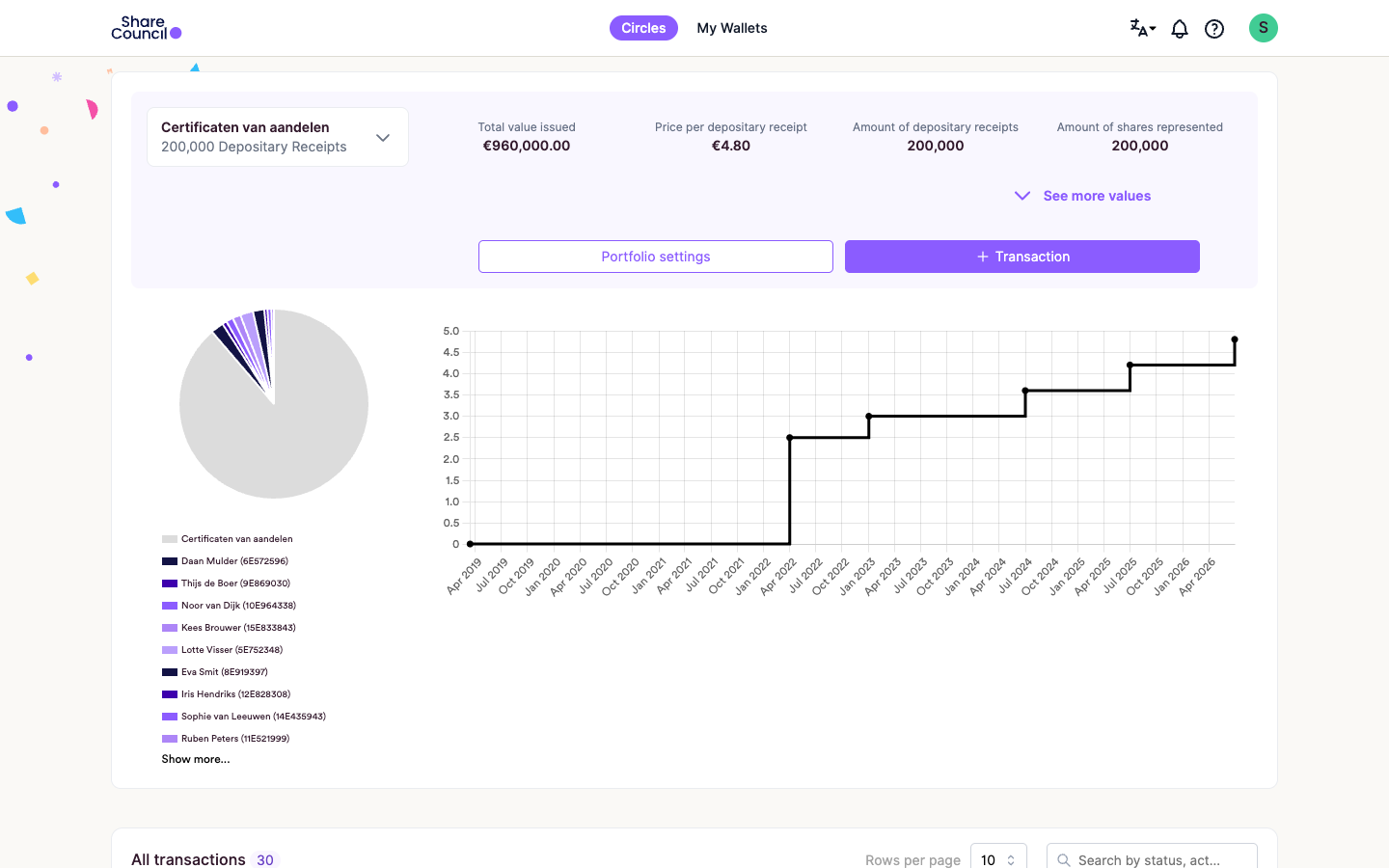
The BV's shareholder register has five holders: the founders Sanne (350,000 shares) and Joris (330,000), the STAK (200,000), the angel investor Mirjam (60,000) and an investment fund (60,000). Together that is 1,000,000 shares. The STAK has issued 200,000 certificates, one per share it holds. About 33,500 of them have been placed with holders, and about 166,500 are still with the STAK. If the BV register says the STAK holds 200,000 shares and the certificates only add up to 199,500, someone has to find out why.
A transfer with a deed and certificate numbers
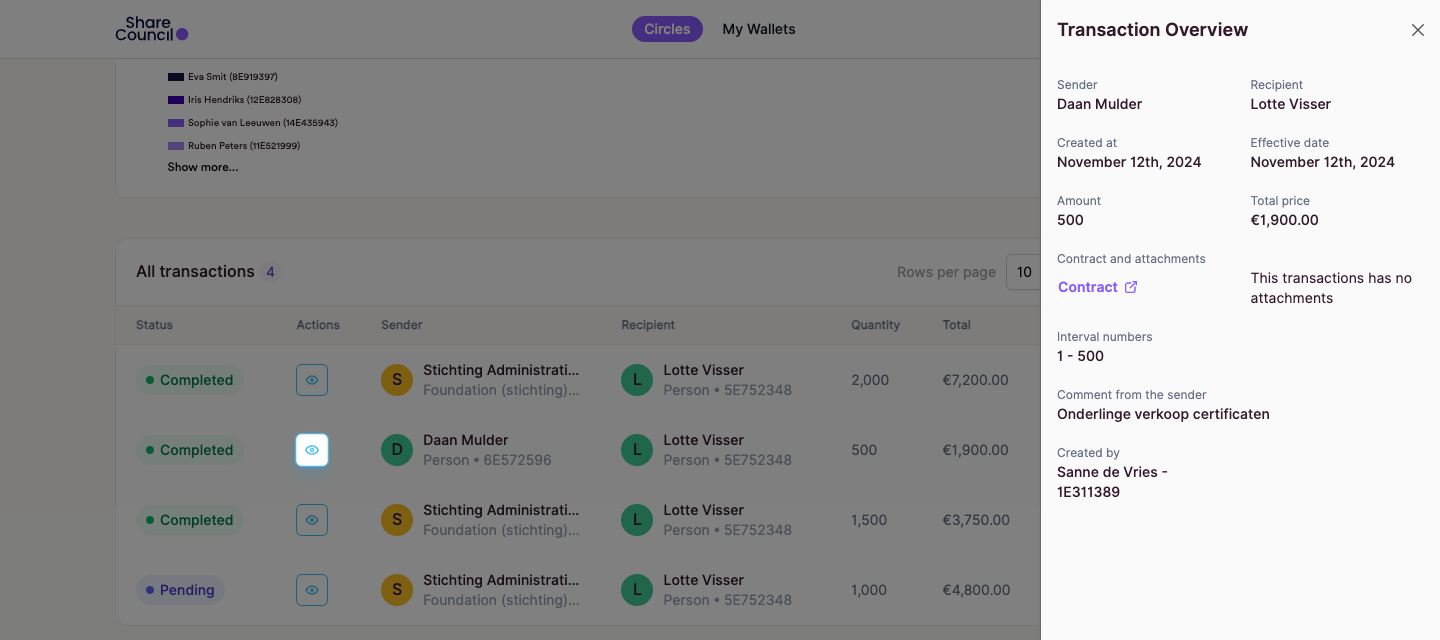
On 12 November 2024 Daan, who works in the workshop, sold 500 certificates to his colleague Lotte at €3.80 each, so €1,900 in total. The record shows both parties, the date, the price and the certificate numbers that moved (1 to 500), with the contract linked to it. Certificates move between people without a notary, as our STAK page explains. On Share Council both sides sign the transfer deed in the platform, our team sets up your deed templates, and a priced transfer completes once the payment is recorded.
A price every year
Tulpwerk's staff bought certificates from the STAK at €3.00 in March 2023, €3.60 in March 2024 and €4.20 in March 2025. The yearly valuation by Equidam on 30 June 2026 set €4.80 per share. Each price is stored with its date and report, so the next round and every holder's statement use the right one.
On Share Council the shares and certificates sit in one record, with certificate numbers that export to Excel, signed deeds, recorded payments and a dated valuation history. Every holder has their own login and a statement valued on 1 January and 31 December. Keeping the register on Share Council doesn't change who is responsible for it, because by law the BV's board keeps the shareholder register (art. 2:194 BW).
Is there a legal form for steward ownership yet?
There isn't one yet. The coalition agreement includes a plan for a new Dutch legal form, the rentmeestervennootschap, but no bill has been published. On 22 September 2026 the State Secretary for Justice and Security answered written questions about it. He is looking at how company law can give more room to a rentmeestervennootschap and aims to send parliament a letter on it before the end of 2026 (answer to written questions 2026Z16258, 22 September 2026). In a debate on small businesses on 15 October 2026, the minister responding for the government said that a statutory scheme is being worked on and that the letter would come this autumn (Tweede Kamer plenary debate, 15 October 2026). When we checked the official publications on 6 November 2026, we found no bill and no letter on it yet.
Until there is a law, steward-owned companies in the Netherlands usually combine a BV with one or more foundations, often a STAK. Parliament called setting up such a model "relatively costly and time-consuming", because the Civil Code doesn't know the form (motion 29 023 nr. 509).
What does Share Council do and not do?
Share Council keeps the record after the notary is done: the STAK as an entity and as a role on the certificates, certificates at the ratio in your trust conditions, signed transfer deeds, certificate numbers, payments and a dated valuation history. Our team also helps before that point. We work with notaries, and if you start your STAK through us, we prepare the trust conditions up front. You can order Total Legal Structuring and Complete Platform Setup from your account.
The notary still founds the STAK and executes the deed that brings shares into it. The platform has no steward-ownership, asset-lock or golden-share feature. Your articles carry those rules, and we administer the structure they describe. Certificates and STAK roles need a paid plan, and our pricing page lists what each plan includes.
FAQ
Is steward ownership the same as employee ownership?
They are different things. Steward ownership separates control of a company from its financial ownership, while employee ownership gives staff part of the economic stake (AWVN, 30 October 2025). You can combine the two. AWVN describes the engineering firm Haskoning, where employees hold 25% of the shares through a STAK and a foundation run by stewards holds the other 75%. Our page on employee participation in SMEs shows how staff can share in a company through certificates.
Do steward-owned companies grow more slowly?
Research suggests they usually do, possibly because they are more reluctant to take outside capital and invest more cautiously (Holland Management Review, 2025, citing Block and Fathollahi, 2023). The same article cites Danish studies finding that steward-owned firms are as profitable as comparable conventional firms and hold larger profit reserves.
Can a small company do it?
It can, but it is harder. The Holland Management Review authors write that outside Germany and Denmark it is often difficult to set up a fitting structure without bespoke work and high advisory fees, and that the usual models are generally not suited to smaller companies (Holland Management Review, 2025). Starting with part of the shares in a STAK, as Tulpwerk did, keeps the first step smaller. Our article is a STAK suitable for every business? helps you check the fit.
Is steward ownership the same as a STAK?
It isn't. A STAK is a foundation that holds shares and issues certificates for them. It is one of the building blocks a steward-owned structure can use, and companies also use a STAK without steward ownership, for example to let employees share in the company. A STAK has its own risks, which we cover in the risks of a STAK.
Start with a clean record
If the disadvantages that come with the model are acceptable to you, managing the rest starts with a register that is right. See how that works on our steward ownership page. Then create an account, enter your BV and your STAK, and see your structure on one screen.
Sources
- De Korte, N. and Van der Linden, M., "Steward-ownership: een alternatief eigendomsmodel voor (sociale) innovatie", Holland Management Review 215, July-September 2025 (PDF)
- Accountancy Vanmorgen, "Bedrijfsopvolging met steward-ownership: prioriteiten en wensen in kaart", 9 October 2026
- AWVN, "De opmars van steward ownership", 30 October 2025
- Verbeek, W., NR Governance, 8 July 2025
- Managementplatform.nl, 9 November 2025
- Motion Sneller and Zeedijk, Kamerstuk 29 023 nr. 509, 16 April 2024
- Answer to written questions 2026Z16258 (Grinwis), Aanhangsel Handelingen 2026-2027 nr. 77, received 22 September 2026
- Handelingen Tweede Kamer 2025-2026 nr. 93 item 6, debate on small businesses (MKB), 15 October 2026
- business.gov.nl, Financing a company takeover
- Burgerlijk Wetboek Boek 2, art. 194
Share this
No successor for your business? How selling to your employees in stages can work
Business succession options in the Netherlands: family, MBO, MBI or your employees