If there is no successor for your business, you don't need one buyer for all of it. A group of employees can buy it in slices over several years, usually through a STAK. In an ABN AMRO survey, 20% of owners who plan to stop within ten years were looking for a successor but hadn't found one (ABN AMRO, December 2025).
This article is for Dutch owners who want to know whether their own team could buy the company. Tulpwerk is our demo company. The numbers are made up, the screens are real.
This is general information, not tax advice. Check your situation with a tax adviser.
Key takeaways
- In ABN AMRO's December 2025 survey of 519 owners, more of the owners planning to stop within ten years named an employee buy-out (5.9%) than a management buy-out (4.0%).
- Running the company and owning it can pass to different people, so your staff don't each have to become entrepreneurs to own part of it.
- A STAK holds the shares and issues certificates, which lets many employees buy small amounts without each of them becoming a shareholder in the BV.
- A staged sale takes years, you stay involved during that time, and you often wait for part of your money.
What can you do when nobody takes over your business?
You can close, sell to an outside buyer, sell to one manager, or sell to a group of employees in stages. This article is about the last route, and our employee buyout page shows how Share Council supports it round by round.
| Route | Who pays | How long it usually takes | What happens to the team |
|---|---|---|---|
| Close down | Nobody; you sell assets and settle debts | Months | Everyone loses their job |
| Outside buyer (competitor, investor) | The buyer, often with a bank | One deal, after a search that can take years | Depends on the buyer's plans |
| One manager (MBO) | The manager and a bank, sometimes with a loan from you | One deal, sometimes paid in instalments | Stays, under a new owner from inside |
| A group of employees via a STAK | Employees from their savings, round by round, sometimes with a loan from you | Several years, one round at a time | Stays, and part of it becomes owner |
The durations in the table are typical patterns, not measured figures. The only Dutch government figure we found is old: a 2013 letter to parliament put the average business transfer at 4.3 years (Kamerbrief 32637 nr. 76, 2013). For a broader comparison that includes family succession, see business succession options in the Netherlands.
How common is it to have no successor for your business?
It is common enough that you are far from alone. ABN AMRO had Ipsos I&O survey 519 owners for its December 2025 sector report. Of the 68% who want to run their company for at most ten more years, 22% hadn't started on succession and 20% were looking without having found anyone (ABN AMRO, December 2025). The same report, citing CBS data, says almost 13% of owners of firms with at least two workers are 65 or older, up from just over 7% in 2010.
The survey also shows what owners care about. For 24% of the owners who are looking for a successor or have found one, "that employees keep their jobs" is an important consideration. Among owners who want to stop within five years, almost 12% already have an employee in mind as successor, and just over 12% plan to close the business.
The 2013 letter to parliament cites an older KvK study from 2007, in which 25% of businesses closed without a successor (Kamerbrief 32637 nr. 76, 2013). Read that as historical context, because the figure is almost twenty years old.
Why can a group of employees buy when a single one rarely can?
It works because the price is split across many buyers. One employee rarely has the savings or borrowing capacity to buy a whole company, but twenty colleagues who each buy a small slice once a year each need a much smaller amount.
A common objection is that staff are loyal but not entrepreneurs. That objection mixes up running a company and owning it. ABN AMRO's report separates succession in leadership from transfer of ownership, and notes that the two can happen at different times and go to different people (ABN AMRO, December 2025). A warehouse worker who buys certificates doesn't have to run the company. A director does that, whether that is you for a few more years, a manager from inside or someone you hire. The same report lists the employee buy-out as a route in its own right, picked by 5.9% of owners planning to stop within ten years, and says it increases involvement and keeps disruption low.
How does a staged sale to employees work with a STAK?
You bring part of your shares into a STAK, a foundation that holds the shares and issues certificates for them. Employees then buy certificates in rounds, and each round has a price based on a fresh valuation.
The notary sets up the STAK, and moving your BV shares into it needs a notarial deed (art. 2:196 BW). You don't have to arrange that alone, because Share Council works with notaries and our team can coordinate the structure with yours. After that, the BV has one extra shareholder, the STAK, however many employees join, and certificates move between people without a notary, as our STAK page explains. If you want to see how share transfers and new issues work in a BV in general, read how shareholders join and leave a BV.
You may have read about the employee ownership trust. It started as a UK structure, and our blog explains how the UK model works. Your notary or adviser confirms which Dutch structure fits your sale.
Each round needs its own price, because a price that was fair in year one can be too low by year three. Our article on employee buy-ins and valuation explains why an independent price matters to both sides.
How does a staged sale look a few years in?
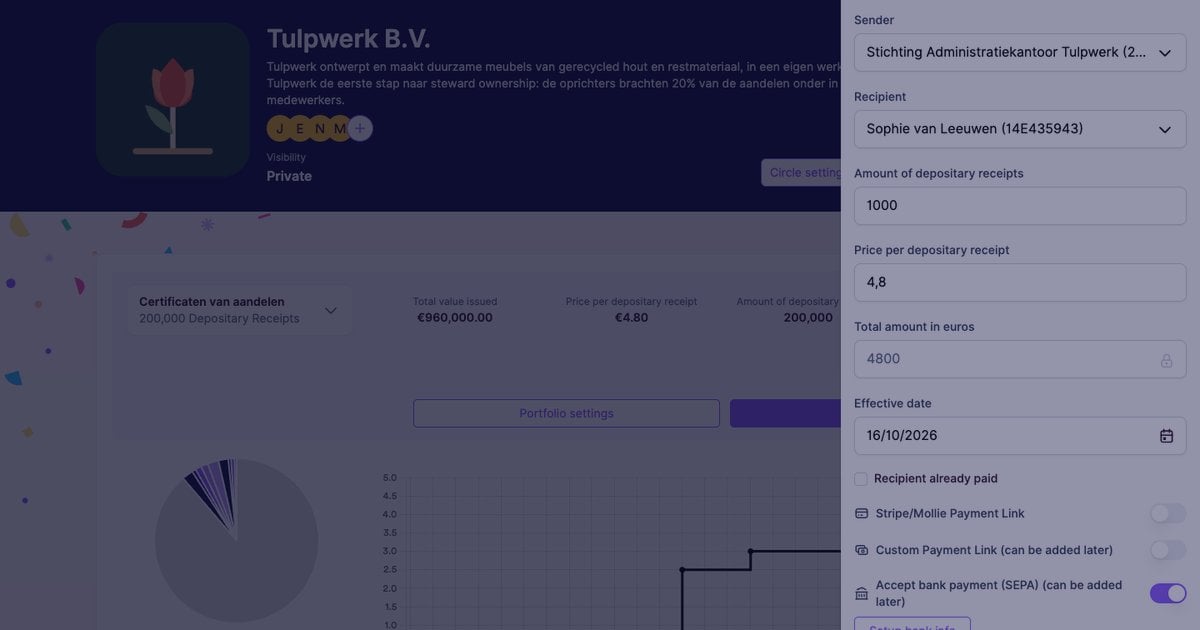
Tulpwerk B.V., our demo furniture maker in Utrecht with about 40 staff, shows the pattern. In January 2023, founders Sanne and Joris brought 20% of the shares into a STAK at €3.00 per share. Staff bought certificates from it in March 2023 at €3.00, in March 2024 at €3.60 and in March 2025 at €4.20, each time at that year's valuation. The June 2026 valuation is €4.80 per share, so the next rounds run at that price.
The founders still hold 68% of the shares. The sale to the team has only just started, and Sanne and Joris still run the company.
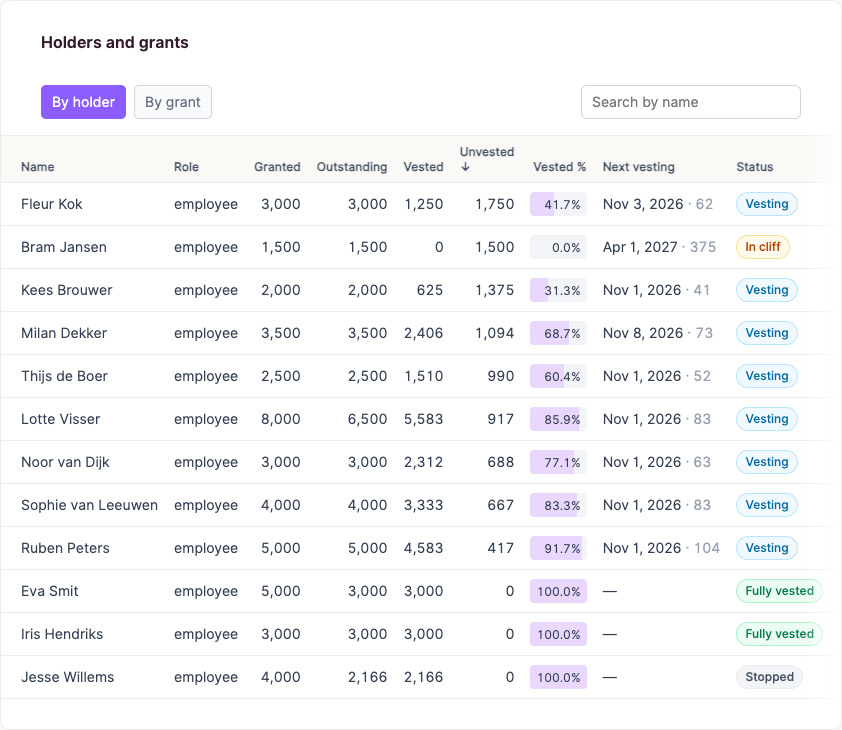
People also leave during a sale that lasts years. Jesse left Tulpwerk on 31 August 2024, and his vesting stopped that day. He kept 2,166 vested options, and the other 1,834 of his 4,000 went back into the pool. Your agreements decide what happens to a leaver's stake. The platform doesn't enforce leaver rules, so the admin records the return or buyback as its own transaction. Our knowledge base article on buying out a former employee from the STAK covers the STAK side.
Who runs the company while the team buys in?
Usually you keep running it, at least at first, or a director you appoint takes over. Certificate holders get the economic rights, such as their part of the dividend, while the STAK board votes on the shares (Share Council, STAK). That lets you hand over ownership step by step while day-to-day management stays with people you trust.
Plan the leadership handover as a separate track. If you want to step back within five years, someone needs to be ready to run the company by then.
What do you give up when you sell to your team in stages?
You mainly give up time and speed. A staged sale can take years, and you stay involved for most of that period, often as director or as a member of the STAK board.
You may also wait for your money. Employees pay round by round, so you receive the price in parts. If you lend part of the price to your buyers, the government's business portal calls that a subordinated loan, which means you are repaid last if the buyer goes bankrupt (business.gov.nl, Financing a company takeover). Agree any such loan in writing with your adviser.
You also give up control over time, so decide early how far you want to go: a minority for the team, a majority, or eventually everything.
When is closing down or an outside buyer the better choice?
Closing or selling outside is better when the business depends on you personally, or when the team can't or won't buy. Closing down fits a firm whose value lies mostly in the owner's own work and relationships. The KVK lists what you need to arrange to stop and deregister (KVK, Stoppen en uitschrijven). Ask your tax adviser to confirm what stopping means for your taxes before you decide.
An outside buyer is the better route when you need the full price soon, or when the company needs capital or knowledge your team doesn't have. A staged sale to employees fits best when the business runs without you day to day, makes a steady profit and has staff who want to stay.
What are the first three steps?
- Get a valuation. You need a defensible value before anyone can talk about price. Use your adviser's valuation, or start one with our partner Equidam from the Valuation tab on Share Council, as our valuation page describes.
- Map the rounds and the structure. Decide who buys, how much moves in each round and whether staff join through a STAK. In a paid expert hour, you, your adviser and our expert put this on paper, and our team can then coordinate the structure with your notary.
- Put today's register in order. Write down who holds what today, including any options or earlier rounds, so the first round starts from a correct position.
Once the structure is in place, you run the rounds on Share Council. The platform keeps the STAK's certificates and a dated valuation history with the report attached. For each purchase you create a transfer at the round's price, the buyer signs and pays the seller, and ownership moves once the seller confirms the payment. Share Council doesn't lend money or arrange financing, so the buyers pay the seller directly. The STAK and its certificates need a paid plan, and our pricing page lists what each plan includes. For a wider view, read how to transition to an employee-owned company.
FAQ
What if my staff don't want to buy?
Nobody can be made to buy, and some employees won't want to risk their savings. Ask early and openly, and consider a small first round to see who joins. If too few people join, you can still sell to a manager or an outside buyer, or close down.
How much tax do I pay when I stop my business?
That depends on your legal form and on how the sale is priced and structured, so this article can't give you a number. Have your tax adviser confirm the treatment before you agree anything with your team.
Do my employees need to become shareholders in the BV?
They don't if you use a STAK. The STAK is the shareholder in the BV, and employees hold certificates that the STAK issues (Share Council, STAK).
Start with your first round
See how a staged sale runs on the employee buyout page. Then create an account, add your company and enter today's owners, so your first round starts from the right numbers.
Sources
Share this
Business succession options in the Netherlands: family, MBO, MBI or your employees

International Expansion with a STAK